Showing posts with label kawasaki. Show all posts
Showing posts with label kawasaki. Show all posts
Tuesday, September 24, 2013
Kawasaki Ninja 650R


Exceptional appearance high speed blossom Kawasaki Ninja 650R
KAWASAKI NINJA® 650R BRINGS REAL WORLD PERFORMANCE TO BOTH THE TWISTIES AND MORNING COMMUTE
Powerful 650 is efficient and easy to ride
With a unique look and feel, the 2007 Kawasaki Ninja® 650R delivers cutting edge design and astonishing versatility. This is a motorcycle that excels in real world riding. With a comfortable seating position and sportbike performance levels, the Ninja 650R is well-suited for freeway commutes, around town errands and weekend track days.
Look at Kawasaki Ninja 650R sportbike and the first impression is one of pure design appreciation. Look a little longer and many of the innovative engine and chassis elements begin to come into play. However, the entire package doesn’t truly project its intended engineering outcome until the motorcycle is viewed with a rider seemingly melded into its unique posture. Because the 650R was meant to have broad rider appeal, Kawasaki’s development team began its task with the rider – not the motorcycle.
After studying every kind of rider, and all types of riding, Kawasaki’s engineers focused on the human-machine interface. Different riding positions were examined to discover which instilled the most confidence. Narrowing the distance between the footpegs and striving for a lower seat height and low effort controls all played into the design effort.
The compact liquid-cooled, fuel-injected, DOHC, 8-valve 649cc parallel twin engine delivers a smooth responsiveness that is tuned for rider-friendly power characteristics – especially in the low and medium rpm ranges. It is a power delivery that will inspire confidence in new motorcyclists. Its excellent mid-range characteristics will make the 650R a natural in commuting environments, and slipping in and out of traffic will be a cinch thanks to its lightweight trellis frame and responsive steering.
The 650R’s engine may be tuned for manageable power delivery, but it also has outstanding roll-on response when making a highway pass and more than enough power to make it an entertaining trackday companion. Kawasaki engineers called on their vast experience building Ninja supersport machines to develop a motorcycle possessing performance characteristics that will be a match for anything currently available in the middleweight arena, including those with larger displacement.
Ultimately, this exceptionally well-proportioned Ninja 650R represents a genre of motorcycle which is at home with both novice and experienced riders – and one that will be seen equally in daily midtown commuting situations as well as back-road-blasting on the weekends.
FEATURES:
Unique features
- Aggressive Ninja styling
- Powerful parallel-twin engine
- Compact size and weight
- Low seat height
- Aggressive Ninja styling
- Powerful parallel-twin engine
- Compact size and weight
- Low seat height
Engine
- 649cc twin-cylinder, DOHC engine
- Parallel twin engine is the most compact in its category. The engine is considerably smaller than that of the Ninja 500 and helps reduce the dimension of the entire motorcycle
- Tuned to deliver smooth, responsive power in the low-to mid-rpm range with exceptional roll-on response for negotiating city traffic
- Triangular crank and transmission shaft layout makes the engine very short from front to back, a semi-dry sump oil system reduces overall engine height, while narrow pitch of the chrome composite plated aluminum cylinders helps reduce engine width
- Muffler with 3-way catalyzer and bullet-tip opening is mounted below the engine to help lower the center of gravity and aid weight centralization
- 180-degree crankshaft plus balancer shaft for extremely smooth engine operation
- Oil jets on the connecting rod big ends spray oil on the undersides of the pistons to aid cooling
- 649cc twin-cylinder, DOHC engine
- Parallel twin engine is the most compact in its category. The engine is considerably smaller than that of the Ninja 500 and helps reduce the dimension of the entire motorcycle
- Tuned to deliver smooth, responsive power in the low-to mid-rpm range with exceptional roll-on response for negotiating city traffic
- Triangular crank and transmission shaft layout makes the engine very short from front to back, a semi-dry sump oil system reduces overall engine height, while narrow pitch of the chrome composite plated aluminum cylinders helps reduce engine width
- Muffler with 3-way catalyzer and bullet-tip opening is mounted below the engine to help lower the center of gravity and aid weight centralization
- 180-degree crankshaft plus balancer shaft for extremely smooth engine operation
- Oil jets on the connecting rod big ends spray oil on the undersides of the pistons to aid cooling
Liquid Cooling
- Maintains consistent engine temperatures for long engine life and sustained power during hard use
- Allows closer engine tolerances for more horsepower
- Coolant is routed through the engine cases to reduce external hoses
- Maintains consistent engine temperatures for long engine life and sustained power during hard use
- Allows closer engine tolerances for more horsepower
- Coolant is routed through the engine cases to reduce external hoses
Digital Fuel Injection
- 38mm Keihin throttle bodies feature sub-throttle valves for optimum performance and rideability. The sub-throttles, located behind the main throttle valves, are controlled by the ECU so that the DFI system gives a more precise throttle response, similar to a constant-velocity carburetor
- Precise fuel injection plus exhaust catalyzer significantly reduce emissions
- Automatic fast idle system makes starting and warm-up easy
- 38mm Keihin throttle bodies feature sub-throttle valves for optimum performance and rideability. The sub-throttles, located behind the main throttle valves, are controlled by the ECU so that the DFI system gives a more precise throttle response, similar to a constant-velocity carburetor
- Precise fuel injection plus exhaust catalyzer significantly reduce emissions
- Automatic fast idle system makes starting and warm-up easy
Digital Capacitor Discharge Ignition (CDI) System
- Microprocessor-controlled timing never needs adjustment and is ultra-responsive to engine needs
- Spark plug mounted “stick” ignition coils are compact and help reduce weight
- Microprocessor-controlled timing never needs adjustment and is ultra-responsive to engine needs
- Spark plug mounted “stick” ignition coils are compact and help reduce weight
Six-Speed Transmission
- Cassette-style transmission puts the transmission shafts and shifts into a compact layout that is easily removed as a single unit from the cases for easier maintenance
- Cassette-style transmission puts the transmission shafts and shifts into a compact layout that is easily removed as a single unit from the cases for easier maintenance
Trellis Frame
- High tensile steel trellis frame is small and light
- Designed using 3-dimensional computer analysis to achieve the optimum stiffness balance for better handling
- Narrow at the knees and feet for rider comfort and control
- High tensile steel trellis frame is small and light
- Designed using 3-dimensional computer analysis to achieve the optimum stiffness balance for better handling
- Narrow at the knees and feet for rider comfort and control
Single-shock Rear Suspension
- Braced swingarm and offset, laydown single rear and shock complement the frame design to create an integrated line flowing from the steering head to the rear hub
- Short, compact frame and engine design allows the swingarm to be longer, which helps improve overall handling
- Braced swingarm and offset, laydown single rear and shock complement the frame design to create an integrated line flowing from the steering head to the rear hub
- Short, compact frame and engine design allows the swingarm to be longer, which helps improve overall handling
Triple Petal Design Brake Discs
- Petal design rotors offer improved cooling and warp resistance
- Same rotor design as found on the Ninja ZX™-6R and ZX-10R supersports machines
- Petal design rotors offer improved cooling and warp resistance
- Same rotor design as found on the Ninja ZX™-6R and ZX-10R supersports machines
Six-spoke wheels
- With the same engineering as the Ninja ZX-6R and ZX-10R, the six-spoke design requires much less material between spokes so that the rim thickness is thinner and overall wheel weight is reduced
- With the same engineering as the Ninja ZX-6R and ZX-10R, the six-spoke design requires much less material between spokes so that the rim thickness is thinner and overall wheel weight is reduced
Confidence-Inspiring Cockpit
- Low, narrow seat combined with the slim overall design allows riders to firmly plant both feet on the ground when stopped
- Carefully designed ergonomics result in a natural, comfortable riding position
- Textured seat cover helps keep the rider planted
- Low, narrow seat combined with the slim overall design allows riders to firmly plant both feet on the ground when stopped
- Carefully designed ergonomics result in a natural, comfortable riding position
- Textured seat cover helps keep the rider planted
Bodywork
- Stylish full fairing with aerodynamic windscreen cuts through the wind and helps protect the rider
- Integrated front turn signals with clear lenses enhance appearance
- Stylish full fairing with aerodynamic windscreen cuts through the wind and helps protect the rider
- Integrated front turn signals with clear lenses enhance appearance
Review
Story by: Gabe Ets-Hokin, Feature Editor, January 2006
Todays story starts way back in 1987, when Honda introduced an unpretentious little motorcycle with a mildly-tuned, liquid-cooled 647cc V-twin engine in a rigid aluminum frame. Priced almost as high as its fully-faired and much more powerful cousin, the 600 Hurricane, the Hawk GT sold about as well as Ann Coulter t-shirts at a Phish concert. However, savvy enthusiasts quickly recognized that with a few choice suspension and engine modifications, the Hawk was an incredibly sweet-handling and fun bike that did double duty as a lightweight racer. Many racing clubs had classes filled completely with Honda Hawks, as no other manufacturer made a middleweight twin with the Hawks potential.
That all changed in 1998, when Suzuki introduced the SV650. With a stiff aluminum frame and swingarm and modern suspension and wheel sizes, the SV was virtually as good as a heavily modified Hawk right out of the showroom. The icing on this cake was a smooth, four-valve liquid-cooled 90-degree V-twin that made 68 hp with a stock exhaust, a power output that a Hawk could achieve only by being a heavily breathed-on grenade. By the end of the 1999 racing season, Hawks were winning races only in the hands of the most skilled and dedicated riders. The popularity of the SV as a street bike ensured a steady supply of cheap race bikes, and seven years later, club racing grids are packed with SV650s.
Sean went out on the Suzuki first to scuff in the new tires. When he came back, he was all smiles...
Last year, Kawasaki showed an interesting bike built for the European market. The ER-6n is a naked standard with a steel trellis frame and a sophisticated 650cc parallel-twin motor. Power output was claimed at 69.7 hp, clearly targeting the second-generation SVs 71.1 claimed hp. The weird styling and lack of full fairing meant this bike probably would never come to American riders.
Imagine our surprise when we got invited to the introduction for Kawasakis all-new for 2006 Ninja 650R. Petes day aboard the new bike revealed a nice-handling little bike that was let down only by budget suspension and braking components. We also found out that a unit would be available for a full test in just a few weeks.
We knew our readers would want to know how this bike -- the first serious competition for the SV available in the US -- would do against the Suzuki twin, so we called up Suzuki and begged for an SV650 to test as well. All we had to decide was which flavor SV to compare it to. Some of us felt the standard SV would be a closer match, as the Kawi has tall bars that would feel very different from the S models clip-ons on a racetrack, where the other school of thought held the majority of readers would feel only bikes with fairings should be compared, as a buyer in the market for a faring-ed bike wouldnt consider a naked, and vice-versa. In the end, the fairing people won, and Suzuki graciously and kindly gave up a fresh-from-the-crate 2006 SV650S.
Both Publisher Sean Alexander and I are club racers and trackday junkies with many miles on SV650s, so we wanted to see how the two bikes stacked up on the racetrack. A few phone calls secured us a trip to the Streets of Willow racetrack, courtesy of Hyperclub trackdays, and a call to Michelin got us two new sets of Pilot Power street/trackday tires.
After a week of all kinds of riding, from the track to the canyons, from bumpy LA freeways and city streets to the smooth sweepers of the Angeles Crest, we think we have enough data to have an intelligent opinion on who makes the best 650 twin streetbike. Does the Kawi have what it takes to unseat the SV from its middleweight-twins throne?
The Contenders
2006 Suzuki SV650S :: 71.15 hp :: $6,449 :: Friendly and Furious
Completely revamped for 2003, the SV650S is an awful lot of motorcycle for $6,449. It uses the same basic formula that was so successful in 1999 with just enough tweaks to keep it fresh and modern.
The heart of the SV is the liquid-cooled, four-valve per cylinder V-twin motor. It uses an 81 mm bore and 62.6 mm stroke and precise electronic fuel injection to pump out 71.15 hp at 9,000 rpm; an unheard of number from a stock 650 twin not so long ago. The Vincent Black Shadow -- one of the most feared bikes ever-- made less than that. Do you still dismiss this as a "beginner" bike?
If only a Vincent had such a good chassis. The SVs "truss"-style frame was all-new for 2003, with a boxier, more creased appearance than the old one. It retained the aluminum swingarm and linkage-type rear suspension of the old bike, along with a 41 mm damper-rod fork. The front and rear suspensions are adjustable for preload only. Wheels are 3-spoke aluminum jobs shod with Dunlop D220s, a 120/60-17 in front followed 56.3" behind by a 160/60-17 rear. Braking is handled by a trio of Tokico two-piston sliding-pin calipers and 290 mm front discs- the rear disc is 220 mm.
Perched on top is 1980s-esque bodywork with lots more sharp edges. Our 2006 was in a fetching shade of red, the bodywork contrasting nicely with the black frame and wheels. There are plenty of amenities, like a metal grabrail for your passenger and a hazard light. The LCD speedometer sits above the tachometer. As a bonus, you can view the coolant temperature and clock at the same time. The bike weighs in at a claimed dry weight of just 372 pounds.
Aside from the Duran Duran-esque fairing and five extra Ben Franklins, the S differs from the standard version of the SV650 by having higher and more rearset footpegs, low clip-on handlebars, a slightly shorter swingarm, and taller gearing. Its a complete package that looks like something much more powerful, expensive and sophisticated than it is, which partially explains the bikes continuing success. What does the Ninja need to surpass it?
2006 Kawasaki EX650R :: 65.65 hp :: $6,299 :: Meet The New Kid
Lest Petes endurance of the long tech briefing go in vain, check out his coverage of the 650Rs press introduction. If youd rather have me give you a quick rundown, well start with the motor.
Kawasakis engineers faced a daunting task: make a motor that matches the SVs power output without making a peaky mess that intimidates novice riders while saving enough money to keep the price competitive. One way to do this is to use a parallel twin powerplant. A single cylinder head saves money in many ways: theres only one cylinder block, one cam chain, one cam chain tensioner, two cam shafts instead of four, and so on. Additionally, its more compact, saving mass and making it easy to package.
To inform you cynics out there, its not a bored-and-stroked EX500 motor. With a very oversquare 83 mm bore and 60 mm stroke, its a much more compact and modern design, with a cassette-style gearbox, semi-dry oil sump and liner-less cylinders to make it smaller than the 500. A 180-degree crank and balance shaft keep it smooth, and 38 mm injectors directed by a microprocessor-controlled engine management system keep it precisely fueled.
The motor nests in a slick red-painted steel trellis-style tube frame thats designed to be narrow, light and compact. The most remarkable feature of the frame is the "laydown"-style rear shock adjustable only for preload (but incredibly easy to adjust- you dont even have to bend over). The 41 mm damper-rod fork is non-adjustable.
Brakes and wheels are nothing fancy. The six-spoke wheels sit just 55.3" apart and carry Bridgestone BT-020s, a 120/70-17 in front and a 160/60-17 on the back hoop. The brake calipers look just like the two-piston units on the SV, but with the fashionable "petal"-style 300 mm rotors like those found on the ZX-6R and ZX-10R.
Its wrapped up in a muted, sophisticated fairing with a chest-height windscreen and integrated turn signals. Large integrated footpeg brackets carry the rider and passenger pegs on one immense unit, which will be challenging for racers to modify. The seat is carefully styled to blend in with the bikes lines and is very narrow and low at the front, but thickly padded and wider at the rear. The handlebars are high and pulled back, but not too wide.
...For $6,299, this is a nicely-finished, good-looking bike.
Instrumentation is a bit spare, with no temperature gauge to distract the rider. There is a clock, dual tripmeters, and hazard lights as well. The build quality is just OK; the unit appears nicely designed, but the plastic is thin and some plastic panels have unsightly gaps and seams. Still, for $6,299, this is a nicely-finished, good-looking bike.
Todays story starts way back in 1987, when Honda introduced an unpretentious little motorcycle with a mildly-tuned, liquid-cooled 647cc V-twin engine in a rigid aluminum frame. Priced almost as high as its fully-faired and much more powerful cousin, the 600 Hurricane, the Hawk GT sold about as well as Ann Coulter t-shirts at a Phish concert. However, savvy enthusiasts quickly recognized that with a few choice suspension and engine modifications, the Hawk was an incredibly sweet-handling and fun bike that did double duty as a lightweight racer. Many racing clubs had classes filled completely with Honda Hawks, as no other manufacturer made a middleweight twin with the Hawks potential.
That all changed in 1998, when Suzuki introduced the SV650. With a stiff aluminum frame and swingarm and modern suspension and wheel sizes, the SV was virtually as good as a heavily modified Hawk right out of the showroom. The icing on this cake was a smooth, four-valve liquid-cooled 90-degree V-twin that made 68 hp with a stock exhaust, a power output that a Hawk could achieve only by being a heavily breathed-on grenade. By the end of the 1999 racing season, Hawks were winning races only in the hands of the most skilled and dedicated riders. The popularity of the SV as a street bike ensured a steady supply of cheap race bikes, and seven years later, club racing grids are packed with SV650s.
Sean went out on the Suzuki first to scuff in the new tires. When he came back, he was all smiles...
Last year, Kawasaki showed an interesting bike built for the European market. The ER-6n is a naked standard with a steel trellis frame and a sophisticated 650cc parallel-twin motor. Power output was claimed at 69.7 hp, clearly targeting the second-generation SVs 71.1 claimed hp. The weird styling and lack of full fairing meant this bike probably would never come to American riders.
Imagine our surprise when we got invited to the introduction for Kawasakis all-new for 2006 Ninja 650R. Petes day aboard the new bike revealed a nice-handling little bike that was let down only by budget suspension and braking components. We also found out that a unit would be available for a full test in just a few weeks.
We knew our readers would want to know how this bike -- the first serious competition for the SV available in the US -- would do against the Suzuki twin, so we called up Suzuki and begged for an SV650 to test as well. All we had to decide was which flavor SV to compare it to. Some of us felt the standard SV would be a closer match, as the Kawi has tall bars that would feel very different from the S models clip-ons on a racetrack, where the other school of thought held the majority of readers would feel only bikes with fairings should be compared, as a buyer in the market for a faring-ed bike wouldnt consider a naked, and vice-versa. In the end, the fairing people won, and Suzuki graciously and kindly gave up a fresh-from-the-crate 2006 SV650S.
Both Publisher Sean Alexander and I are club racers and trackday junkies with many miles on SV650s, so we wanted to see how the two bikes stacked up on the racetrack. A few phone calls secured us a trip to the Streets of Willow racetrack, courtesy of Hyperclub trackdays, and a call to Michelin got us two new sets of Pilot Power street/trackday tires.
After a week of all kinds of riding, from the track to the canyons, from bumpy LA freeways and city streets to the smooth sweepers of the Angeles Crest, we think we have enough data to have an intelligent opinion on who makes the best 650 twin streetbike. Does the Kawi have what it takes to unseat the SV from its middleweight-twins throne?
The Contenders
2006 Suzuki SV650S :: 71.15 hp :: $6,449 :: Friendly and Furious
Completely revamped for 2003, the SV650S is an awful lot of motorcycle for $6,449. It uses the same basic formula that was so successful in 1999 with just enough tweaks to keep it fresh and modern.
The heart of the SV is the liquid-cooled, four-valve per cylinder V-twin motor. It uses an 81 mm bore and 62.6 mm stroke and precise electronic fuel injection to pump out 71.15 hp at 9,000 rpm; an unheard of number from a stock 650 twin not so long ago. The Vincent Black Shadow -- one of the most feared bikes ever-- made less than that. Do you still dismiss this as a "beginner" bike?
If only a Vincent had such a good chassis. The SVs "truss"-style frame was all-new for 2003, with a boxier, more creased appearance than the old one. It retained the aluminum swingarm and linkage-type rear suspension of the old bike, along with a 41 mm damper-rod fork. The front and rear suspensions are adjustable for preload only. Wheels are 3-spoke aluminum jobs shod with Dunlop D220s, a 120/60-17 in front followed 56.3" behind by a 160/60-17 rear. Braking is handled by a trio of Tokico two-piston sliding-pin calipers and 290 mm front discs- the rear disc is 220 mm.
Perched on top is 1980s-esque bodywork with lots more sharp edges. Our 2006 was in a fetching shade of red, the bodywork contrasting nicely with the black frame and wheels. There are plenty of amenities, like a metal grabrail for your passenger and a hazard light. The LCD speedometer sits above the tachometer. As a bonus, you can view the coolant temperature and clock at the same time. The bike weighs in at a claimed dry weight of just 372 pounds.
Aside from the Duran Duran-esque fairing and five extra Ben Franklins, the S differs from the standard version of the SV650 by having higher and more rearset footpegs, low clip-on handlebars, a slightly shorter swingarm, and taller gearing. Its a complete package that looks like something much more powerful, expensive and sophisticated than it is, which partially explains the bikes continuing success. What does the Ninja need to surpass it?
2006 Kawasaki EX650R :: 65.65 hp :: $6,299 :: Meet The New Kid
Lest Petes endurance of the long tech briefing go in vain, check out his coverage of the 650Rs press introduction. If youd rather have me give you a quick rundown, well start with the motor.
Kawasakis engineers faced a daunting task: make a motor that matches the SVs power output without making a peaky mess that intimidates novice riders while saving enough money to keep the price competitive. One way to do this is to use a parallel twin powerplant. A single cylinder head saves money in many ways: theres only one cylinder block, one cam chain, one cam chain tensioner, two cam shafts instead of four, and so on. Additionally, its more compact, saving mass and making it easy to package.
To inform you cynics out there, its not a bored-and-stroked EX500 motor. With a very oversquare 83 mm bore and 60 mm stroke, its a much more compact and modern design, with a cassette-style gearbox, semi-dry oil sump and liner-less cylinders to make it smaller than the 500. A 180-degree crank and balance shaft keep it smooth, and 38 mm injectors directed by a microprocessor-controlled engine management system keep it precisely fueled.
The motor nests in a slick red-painted steel trellis-style tube frame thats designed to be narrow, light and compact. The most remarkable feature of the frame is the "laydown"-style rear shock adjustable only for preload (but incredibly easy to adjust- you dont even have to bend over). The 41 mm damper-rod fork is non-adjustable.
Brakes and wheels are nothing fancy. The six-spoke wheels sit just 55.3" apart and carry Bridgestone BT-020s, a 120/70-17 in front and a 160/60-17 on the back hoop. The brake calipers look just like the two-piston units on the SV, but with the fashionable "petal"-style 300 mm rotors like those found on the ZX-6R and ZX-10R.
Its wrapped up in a muted, sophisticated fairing with a chest-height windscreen and integrated turn signals. Large integrated footpeg brackets carry the rider and passenger pegs on one immense unit, which will be challenging for racers to modify. The seat is carefully styled to blend in with the bikes lines and is very narrow and low at the front, but thickly padded and wider at the rear. The handlebars are high and pulled back, but not too wide.
...For $6,299, this is a nicely-finished, good-looking bike.
Instrumentation is a bit spare, with no temperature gauge to distract the rider. There is a clock, dual tripmeters, and hazard lights as well. The build quality is just OK; the unit appears nicely designed, but the plastic is thin and some plastic panels have unsightly gaps and seams. Still, for $6,299, this is a nicely-finished, good-looking bike.

Friday, September 20, 2013
Kawasaki
Kawasaki ER-6f
Kawasaki ER-5 Twister
Kawasaki EN 500 Vulcan Classic
Kawasaki GPX 250R
Kawasaki Ninja 250R SE
Kawasaki Ninja 500R
Kawasaki GTR 1400 Concours
Kawasaki KLX 250 Black Special Edition
Kawasaki KLX450R Africa
Kawasaki Ninja 650R
Kawasaki Ninja 1000
Monday, September 9, 2013
Kawasaki Ninja ZX 10R Performance
Kawasaki Ninja ZX-10R Performance Edition Review
- Kawasaki Ninja ZX-10R Performance

The Kawasaki ZX10R changed quite dramatically in the year 2008, for the year 2010 there has been some further modifications in an effort to perfect this machine has been great. Its main focus tracking performance. Without loss of low-and mid-range performance is the all new Kawasaki ZX10R end up having more power than ever before – essentially this is a race ready machine.
Kawasaki has designed a type of traction control on a model which is very helpful ZX10R grip when the throttle a little too much has been applied by the slowdown in the ignition while still allowing more experienced and demanding the option to allow a bicycle rider to move beneath them.
Kawasaki Ninja ZX10R standard come with a slipper clutch which also works incredibly well.
Addition of the secondary injectors to feed into ZX10R Power plant located in the new oval inlet channels to ensure there is better throttle response especially at high rpm. area, while also increasing the smooth delivery of low-end power.
The Speedometer / Cluster Hours of ZX10R Kawasaki has been designed so that riders stay focused longer distances when the speedometer glance thus ensuring that more time was spent focusing on the road.
Kawasaki Ninja ZX-10R Performance Edition gets Akrapovic silencer along with double bubble screen, color coded seat cowl, mini front indicators, plus tank and knee pads, The silencer gives the ZX-10R a 5bhp power gain
- Kawasaki Ninja ZX-10R Performance

2010 Kawasaki ZX-10R Performance Edition Features
High-powered engine
Delivering 200 PS with Ram Air and a super-wide powerband, the Ninja ZX-10R’s engine has performance potential similar to Kawasaki factory superbike race machines.
Delivering 200 PS with Ram Air and a super-wide powerband, the Ninja ZX-10R’s engine has performance potential similar to Kawasaki factory superbike race machines.
Öhlins steering damper
Adjustable Öhlins steering damper with twin-tube design is fitted as standard equipment. The second tube, which acts like a reservoir tank, and the damper internals, ensure stable damping performance even under racing conditions. This race-quality unit was developed in collaboration with Öhlins specially for the Ninja ZX-10R.
Adjustable Öhlins steering damper with twin-tube design is fitted as standard equipment. The second tube, which acts like a reservoir tank, and the damper internals, ensure stable damping performance even under racing conditions. This race-quality unit was developed in collaboration with Öhlins specially for the Ninja ZX-10R.
Optimised sports ergonomics
Ergonomics; most especially the tank and seat, maximise the rider’s contact with the bike. The handlebar/seat/pegs relationship offers a naturally aggressive riding position, ideal for riding on the track.
Ergonomics; most especially the tank and seat, maximise the rider’s contact with the bike. The handlebar/seat/pegs relationship offers a naturally aggressive riding position, ideal for riding on the track.
Highly communicative chassis
The optimised stiffness balance of Kawasaki’s unique backbone twin-tube frame contributes to the ZX-10R’s superb rider feedback. Some of the chassis technology used included shaping the frame’s pressed parts: the convex pieces, not really noticeable to the naked eye, to help alleviate stress concentrations.
The optimised stiffness balance of Kawasaki’s unique backbone twin-tube frame contributes to the ZX-10R’s superb rider feedback. Some of the chassis technology used included shaping the frame’s pressed parts: the convex pieces, not really noticeable to the naked eye, to help alleviate stress concentrations.
Enhanced styling
New front cowl gives the Ninja ZX-10R a stronger family resemblance to its smaller sibling, the Ninja ZX-6R. Revisions to the minimalist bodywork and a new muffler design contribute to a lighter looking appearance.
New front cowl gives the Ninja ZX-10R a stronger family resemblance to its smaller sibling, the Ninja ZX-6R. Revisions to the minimalist bodywork and a new muffler design contribute to a lighter looking appearance.
Adjustable back-torque limiting clutch
Easily adjustable back-torque limiting clutch enables smooth downshifts. This highly acclaimed feature is one of the main contributors to the rear’s stable composure under hard braking.
Easily adjustable back-torque limiting clutch enables smooth downshifts. This highly acclaimed feature is one of the main contributors to the rear’s stable composure under hard braking.
Kawasaki Ignition Management System
In order to offer riders precise control of the engine’s powerful output, the Ninja ZX-10R is equipped with an advanced ignition management system. Designed to deliver precise power according to the rider’s intentions, the system ensures smooth throttle response, curtails sudden spikes in engine speed, and also effectively protects the engine and exhaust catalysers from damage.
In order to offer riders precise control of the engine’s powerful output, the Ninja ZX-10R is equipped with an advanced ignition management system. Designed to deliver precise power according to the rider’s intentions, the system ensures smooth throttle response, curtails sudden spikes in engine speed, and also effectively protects the engine and exhaust catalysers from damage.
Instruments
The 10R’s cluster instrument package features special UV-blocking glass, making the LED display brighter and easier to read. The depth effect of the LCD screen is striking while the colour-coded tachometer indicates an optimal operating rev range in green.
The 10R’s cluster instrument package features special UV-blocking glass, making the LED display brighter and easier to read. The depth effect of the LCD screen is striking while the colour-coded tachometer indicates an optimal operating rev range in green.
Wednesday, September 4, 2013
2009 Kawasaki Ninja 500R
2009 Kawasaki Ninja 500R
Exciting two-wheel fun, practical two-wheel efficiency
Practicality is the Kawasaki Ninja 500r biggest asset as it strikes an ideal balance between function, form and budget that’s rarely achieved in the sport bike world. A sensible sportbike, the 500R is ready to rip, yet remains friendly enough for beginners to feel confident in its manners.
 At the heart of this excellent platform is the Ninja 500R’s 498cc liquid-cooled, parallel twin-cylinder four-stroke engine. With dual overhead cams and four valves per cylinder, the robust motor is both beginner-friendly and rousing to expert riders. No slouch, this half-liter engine has enough gusto to let novices expand their skills and keep even the most seasoned riders quite happy exploring the upper end of its rev range.
Letting the high-performance engine live to its full potential is a lightweight and compact design. One of the major selling points for the Ninja 500R is its great-handling enabled by its large-diameter 37mm fork tubes and UNI-TRAK® rear suspension system utilizing a progressive linkage similar to the larger-displacement Ninja models. With the motor and chassis combo, the bike begs to be taken out on twisty back roads.
And the Ninja 500R also shares the same sporty styling of its bigger siblings, with an aerodynamic half-fairing that provides wind protection for the rider and is stylishly complemented by a lower fairing
source: www.totalmotorcycle.com
Read more »
Exciting two-wheel fun, practical two-wheel efficiency
Practicality is the Kawasaki Ninja 500r biggest asset as it strikes an ideal balance between function, form and budget that’s rarely achieved in the sport bike world. A sensible sportbike, the 500R is ready to rip, yet remains friendly enough for beginners to feel confident in its manners.
Letting the high-performance engine live to its full potential is a lightweight and compact design. One of the major selling points for the Ninja 500R is its great-handling enabled by its large-diameter 37mm fork tubes and UNI-TRAK® rear suspension system utilizing a progressive linkage similar to the larger-displacement Ninja models. With the motor and chassis combo, the bike begs to be taken out on twisty back roads.
And the Ninja 500R also shares the same sporty styling of its bigger siblings, with an aerodynamic half-fairing that provides wind protection for the rider and is stylishly complemented by a lower fairing
source: www.totalmotorcycle.com
Friday, August 30, 2013
Kawasaki klk 110
Kawasaki klx series Certain mini motorcycles have taken on sort of a double life over the years, in that adults appreciate them as much as kids and beginners do. So it is with Kawasaki’s KLX™110, which just might be the most versatile mini bike of all time. And it’s easy to see why: The little KLX is simply a blast to ride, packing the sort of confidence-inspiring and easy-to-access performance that makes kids, beginners and more experienced riders grin within their helmets all day long.

Packed with cool performance and convenience features, the 2011 KLX110 includes push-button electric starting that makes it easy to get going. There’s also a traditional kick-start lever for backup duty, but once riders get used to the magic button they’re likely to forget all about it. The super-dependable 111cc four-stroke engine is surprisingly torquey and easy to use, and incorporates Kawasaki’s latest intake, exhaust and ignition thinking, for smooth running and impressive power. The semi-automatic gearbox boasts four speeds to access the KLX’s full spread of torque. And Kawasaki’s automatic centrifugal clutch system, which allows easy no-clutch shifting, lets novice riders concentrate on the ride and not the lever.
Optimum wheel and chassis control is a key factor with any beginner/kids bike, and the KLX obliges with quality suspension front and rear. A single shock with 4.3 inches of travel and plenty of bottoming resistance handles things out back, while a beefy, 30mm telescopic fork offering 4.3 inches of wheel travel tames the bumps up front. Tapered roller bearings at the bottom of the steering stem add durability.
With all these features it makes sense that the 2011 KLX110 mimics its KX™ cousins styling-wise. And that’s why the design team outfitted the bike in radical, KX-inspired bodywork: gas tank, seat, side panels, shrouds and fenders look as if they’re straight off the race winning KX450F. A comfortable, MX-style seat is part of the deal, along with a handlebar bend that gives a high degree of comfort and control to a wide variety of riders.
Comfort. Control. Surprising yet manageable power. Great looks. Legendary Kawasaki reliability. Push-button starting. And all this in a small, kid- and novice-friendly package. It’s no wonder adults and veterans love riding little KLX when the kids are tuckered out.
source:
Tuesday, August 6, 2013
Modifikasi Kawasaki Ninja 150R
Manufacturer : KAWASAKI
TYPE: NINJA 150R
COLOR: GREEN
YEAR: 2002
CONDITION OF MACHINES: 99.9%
CONDITION OF BODY: Full Color + FULL CHROME
Specifications:
* FAIRING + drum front & front DISK: KAWASAKI SERVICO
* Steering : HAVE A KAWASAKI NINJA KRR
* Gir + CHAIN: MERK TK
* VELG: MERK TK
* KNALPOT: STANDART RACING
* Airbrush: Airbrush Tomi
* CHROME: LIGHT PEARL
 Kawasaki Ninja 150R Modification Picture
 Modification of Kawasaki Ninja 150R Rear View
 Kawasaki Ninja 150R Modification Engine
 Modifikasi Kawasaki Ninja 150R Tires
Read more »
TYPE: NINJA 150R
COLOR: GREEN
YEAR: 2002
CONDITION OF MACHINES: 99.9%
CONDITION OF BODY: Full Color + FULL CHROME
Specifications:
* FAIRING + drum front & front DISK: KAWASAKI SERVICO
* Steering : HAVE A KAWASAKI NINJA KRR
* Gir + CHAIN: MERK TK
* VELG: MERK TK
* KNALPOT: STANDART RACING
* Airbrush: Airbrush Tomi
* CHROME: LIGHT PEARL
Kawasaki Ninja 150R Modification PictureModification of Kawasaki Ninja 150R Rear ViewKawasaki Ninja 150R Modification EngineModifikasi Kawasaki Ninja 150R Tires
Monday, July 22, 2013
2011 Kawasaki Vulcan 1700 Classic LT
The 2011 Kawasaki Vulcan 1700 Classic LT improved with exhaust pipe heat shielding reduces radiant heat felt by the rider. Improved radiator ducting helps keep heat away from the rider’s right leg. A 5mm shorter coolant pipe makes it possible to remove the pipe without removing the alternator cover, simplifying oil-screen maintenance with Adjustable Windscreen : Adjustable handlebar-mounted optically correct windscreen is shaped for optimum airflow management without compromising the Vulcan 1700 Classic LT’s cruiser styling. Strong chrome plated steel supports. Two-position height adjustability accommodates different sized riders. Studded Seats and Passenger Backrest, Studded rider and passenger seats feature a sculpted shape that complements the rich visual tone of the bodywork, Detailed with ½-inch diameter chrome plated brass studs, Passenger backrest has strong chrome plated steel supports for a secure feeling and traditional cruiser styling. Saddlebags: Made of reinforced top grain cowhide carefully selected with minimal flaws and deep dyed to resist finish damage due to minor scrapes, Slant top opening lid, secured with two 1.5-inch wide leather straps with chrome buckles and concealed quick release fasteners, Dual panel lid construction with embossed Vulcan logo detail, Metal reinforced upper edge help bags hold their shape, Rolled and riveted top lid minimizes water intrusion, Chrome plated brass stud accents match the seats. Powerful 1700cc V-Twin engine: Liquid cooled, 4-valve per cylinder, fuel-injected 1700cc 52° V-twin engine, Long-stroke 102 x 104mm bore and stroke helps deliver massive torque, distinctive V-twin feel, Valve system uses a single overhead cam arrangement instead of pushrods, for quick revability and enhanced mid-high rpm power, Semi-dry sump allows a low crankshaft placement and a long piston stroke without increasing engine height, Single-pin crank accentuates the engine’s V-twin character by providing strong power-pulses, Large capacity airbox is located on both sides of the engine, Small-diameter iridium sparkplugs reach deep into the combustion chamber for high combustion efficiency, especially during low-load operation, Dual staggered mufflers offer a rich sound and stylish appearance, Engine tuning offers superior acceleration in the 50-70mph range, Even in overdrive, the engine pulls strongly, facilitating overtaking at highway speeds.

Next Generation FI from 2011 Kawasaki Vulcan 1700 Classic LT
Based on the systems used by the Ninja 650R and Vulcan 900 motorcycles. Utilizes one sensor in place of the usual three, for simplicity and light weight. The Vulcan 1700 takes advantage of FI and exhaust tuning optimized for maximum performance in the low-mid-rpm range, giving it plenty of grunt on the boulevard. Electronic Throttle Valve System. Fully electronic throttle actuation system enables the ECU to control the volume of intake air (via throttle valve angle) and fuel (via fuel injector timing) delivered to the engine. Optimized fuel injector timing and throttle valve position results in accurate, powerful engine response. Control of both fuel injection and airflow provides easy starting and precise cold-engine idle speed control. From the rider’s perspective, the ETV works like a standard cable-operated throttle. the throttle grip is still connected to cables, so the feel at the grip is the same. Twisting the throttle turns a pulley on the throttle body which triggers the Accelerator Position Sensor (APS) to send a signal to the ECU, which then modulates the throttle valves via a DC motor. Accurate throttle position is relayed to the ECU by a Throttle Position Sensor (TPS). APS and TPS send two sets of signals to the ECU for system redundancy in the unlikely event of a sensor failure. On Board Diagnostics: Diagnostic system allows self testing of the electronic systems on the Vulcan 1700, Displays codes on the instrumentation, which can be read by owner from the accessory manual

Six-Speed Transmission / Final Drive
5th and 6th are overdrive gears, contributing to stress-free riding and excellent fuel economy when cruising at highway speeds, 28mm carbon fiber final drive belt offers a 40 percent increase in tensile strength compared to current Kevlar belts, allowing use of a belt only 2mm wider than the Kevlar belt on Vulcan 900, Belt drive system is quiet, efficient and offers reduced maintenance compared to a chain
Light Handling Chassis
Compact frame features a short wheelbase, and short distance between the seat and steering head, for great ergonomics and easy maneuverability, Light and slim as possible, the frame minimizes the number of forged parts and trims any unnecessary metal. The only forged parts are areas that require additional strength, the down-tube joint, engine brackets, side-stand bracket, and rear fender/shock absorber bracket, The compact design contributes to light handling and facilitates handling at low speeds, especially when executing precise slow-speed maneuvers like parking or making U-turns. 43mm Telescopic Fork: Provides superb steering feedback, 5.5 inches of travel for excellent ride quality. Dual Adjustable Rear Air-Shocks: Air adjustable spring preload can be tuned to match varying rider and passenger loads, 4-way rebound damping adjustments help the shocks compensate for changes in spring pressure, Chromed shock covers contribute to the bike’s luxurious finish. 9-Spoke Cast Wheels: Allow the use of tubeless tires and complement the Vulcan 1700’s muscular styling, 130/90 front and 170/70 rear radial tires, Tire choice and suspension settings selected to augment the chassis’ light handling characteristics

Brakes
Dual 300mm front and a single 300mm rear disc are squeezed by twin-piston calipers. This braking system is tuned to provide sure, powerful stops
Classic V-twin Appeal
The line created by the top of the airbox and the cylinder heads forms a curved shape that continues to flow through the bike, Deeply chromed engine covers have curved upper surfaces. Their three-dimensional form adds volume and gives a high quality appearance, The edges of the cooling fins receive a special NC treatment that makes them gleam in sunlight, All the non-chromed parts of the engine have a matte black finish that further accentuates the gleaming chrome

Bodywork
The fuel tank’s hand-sculpted contours employ a constantly varying radius, giving the bike a dynamic flowing style which is pleasing both to the eye and to the touch, Its lines flowing through the rest of the bike, the elegantly shaped fuel tank contributes to the Vulcan 1700’s curvaceous figure, LED taillight offers elegant design and excellent long-term durability. Instrumentation: Ignition switch allows on-position key removal; preventing key bunches from scratching the instrument cluster or tank while the bike is in operation, Turning the ignition switch collar to the “OFF” position turns the engine off and necessitates re-insertion of the key to restart, Multi-function LCD displays on the tank-mounted instrument cluster are controlled by switches on the right handlebar. Features include a gear position indicator, fuel gauge, clock, odometer, dual trip meters, remaining range and average fuel consumption, Liberal use of chrome on the engine, fender brackets, light stays, and rear shock covers contrast nicely with the bodywork’s deep, lustrous paint, The sculpted shape of the seat complements the rich visual tone of the bodywork

2011 Kawasaki Vulcan 1700 Classic LT - Specifications
USA MSRP: $14,199 USD
Engine: Four-stroke, liquid-cooled, SOHC, four valve per cylinder, 52° V-twin
Displacement: 1,700cc / 103.7ci
Bore x Stroke: 102 x 104mm
Compression Ratio: 9.5:1
Maximum Torque: 108 lb-ft @ 2,250 rpm
Cooling: Liquid, plus cooling fins
Induction: Digital fuel injection, dual 42mm throttle bodies
Ignition: TCBI with Digital Advance
Transmission: Six-speed with overdrive
Final drive: Belt
Frame: Steel, double-cradle with box-section single-tube backbone
Rake / Trail: 30° / 6.7 in.
Suspension, Front / Wheel Travel: 43mm hydraulic fork / 5.5 in.
Suspension, Rear / Wheel Travel: Swingarm with twin air-assisted shocks, with 4-way rebound damping / 3.1in.
Front Tire: 130/90x16
Rear Tire: 170/70x16
Brakes, Front - Dual 300 mm discs, dual twin-piston calipers
Brakes, Rear: Single 300 mm disc, twin-piston caliper
Overall Length: 98.4 in.
Overall Width: 40.4 in.
Overall Height: 57.7 in.
Ground Clearance: 5.1 in.
Seat Height: 28.3 in.
Wheelbase: 65.6 in.
Curb Weight: 798 lbs.**
Fuel Capacity: 5.3 gal.
Colors: Metallic Imperial Red/Metallic Titanium
MSRP: $14,199
Warranty: 24 Months
Read more »
Next Generation FI from 2011 Kawasaki Vulcan 1700 Classic LT
Based on the systems used by the Ninja 650R and Vulcan 900 motorcycles. Utilizes one sensor in place of the usual three, for simplicity and light weight. The Vulcan 1700 takes advantage of FI and exhaust tuning optimized for maximum performance in the low-mid-rpm range, giving it plenty of grunt on the boulevard. Electronic Throttle Valve System. Fully electronic throttle actuation system enables the ECU to control the volume of intake air (via throttle valve angle) and fuel (via fuel injector timing) delivered to the engine. Optimized fuel injector timing and throttle valve position results in accurate, powerful engine response. Control of both fuel injection and airflow provides easy starting and precise cold-engine idle speed control. From the rider’s perspective, the ETV works like a standard cable-operated throttle. the throttle grip is still connected to cables, so the feel at the grip is the same. Twisting the throttle turns a pulley on the throttle body which triggers the Accelerator Position Sensor (APS) to send a signal to the ECU, which then modulates the throttle valves via a DC motor. Accurate throttle position is relayed to the ECU by a Throttle Position Sensor (TPS). APS and TPS send two sets of signals to the ECU for system redundancy in the unlikely event of a sensor failure. On Board Diagnostics: Diagnostic system allows self testing of the electronic systems on the Vulcan 1700, Displays codes on the instrumentation, which can be read by owner from the accessory manual
Six-Speed Transmission / Final Drive
5th and 6th are overdrive gears, contributing to stress-free riding and excellent fuel economy when cruising at highway speeds, 28mm carbon fiber final drive belt offers a 40 percent increase in tensile strength compared to current Kevlar belts, allowing use of a belt only 2mm wider than the Kevlar belt on Vulcan 900, Belt drive system is quiet, efficient and offers reduced maintenance compared to a chain
Light Handling Chassis
Compact frame features a short wheelbase, and short distance between the seat and steering head, for great ergonomics and easy maneuverability, Light and slim as possible, the frame minimizes the number of forged parts and trims any unnecessary metal. The only forged parts are areas that require additional strength, the down-tube joint, engine brackets, side-stand bracket, and rear fender/shock absorber bracket, The compact design contributes to light handling and facilitates handling at low speeds, especially when executing precise slow-speed maneuvers like parking or making U-turns. 43mm Telescopic Fork: Provides superb steering feedback, 5.5 inches of travel for excellent ride quality. Dual Adjustable Rear Air-Shocks: Air adjustable spring preload can be tuned to match varying rider and passenger loads, 4-way rebound damping adjustments help the shocks compensate for changes in spring pressure, Chromed shock covers contribute to the bike’s luxurious finish. 9-Spoke Cast Wheels: Allow the use of tubeless tires and complement the Vulcan 1700’s muscular styling, 130/90 front and 170/70 rear radial tires, Tire choice and suspension settings selected to augment the chassis’ light handling characteristics
Brakes
Dual 300mm front and a single 300mm rear disc are squeezed by twin-piston calipers. This braking system is tuned to provide sure, powerful stops
Classic V-twin Appeal
The line created by the top of the airbox and the cylinder heads forms a curved shape that continues to flow through the bike, Deeply chromed engine covers have curved upper surfaces. Their three-dimensional form adds volume and gives a high quality appearance, The edges of the cooling fins receive a special NC treatment that makes them gleam in sunlight, All the non-chromed parts of the engine have a matte black finish that further accentuates the gleaming chrome
Bodywork
The fuel tank’s hand-sculpted contours employ a constantly varying radius, giving the bike a dynamic flowing style which is pleasing both to the eye and to the touch, Its lines flowing through the rest of the bike, the elegantly shaped fuel tank contributes to the Vulcan 1700’s curvaceous figure, LED taillight offers elegant design and excellent long-term durability. Instrumentation: Ignition switch allows on-position key removal; preventing key bunches from scratching the instrument cluster or tank while the bike is in operation, Turning the ignition switch collar to the “OFF” position turns the engine off and necessitates re-insertion of the key to restart, Multi-function LCD displays on the tank-mounted instrument cluster are controlled by switches on the right handlebar. Features include a gear position indicator, fuel gauge, clock, odometer, dual trip meters, remaining range and average fuel consumption, Liberal use of chrome on the engine, fender brackets, light stays, and rear shock covers contrast nicely with the bodywork’s deep, lustrous paint, The sculpted shape of the seat complements the rich visual tone of the bodywork
2011 Kawasaki Vulcan 1700 Classic LT - Specifications
USA MSRP: $14,199 USD
Engine: Four-stroke, liquid-cooled, SOHC, four valve per cylinder, 52° V-twin
Displacement: 1,700cc / 103.7ci
Bore x Stroke: 102 x 104mm
Compression Ratio: 9.5:1
Maximum Torque: 108 lb-ft @ 2,250 rpm
Cooling: Liquid, plus cooling fins
Induction: Digital fuel injection, dual 42mm throttle bodies
Ignition: TCBI with Digital Advance
Transmission: Six-speed with overdrive
Final drive: Belt
Frame: Steel, double-cradle with box-section single-tube backbone
Rake / Trail: 30° / 6.7 in.
Suspension, Front / Wheel Travel: 43mm hydraulic fork / 5.5 in.
Suspension, Rear / Wheel Travel: Swingarm with twin air-assisted shocks, with 4-way rebound damping / 3.1in.
Front Tire: 130/90x16
Rear Tire: 170/70x16
Brakes, Front - Dual 300 mm discs, dual twin-piston calipers
Brakes, Rear: Single 300 mm disc, twin-piston caliper
Overall Length: 98.4 in.
Overall Width: 40.4 in.
Overall Height: 57.7 in.
Ground Clearance: 5.1 in.
Seat Height: 28.3 in.
Wheelbase: 65.6 in.
Curb Weight: 798 lbs.**
Fuel Capacity: 5.3 gal.
Colors: Metallic Imperial Red/Metallic Titanium
MSRP: $14,199
Warranty: 24 Months
Wednesday, July 17, 2013
New Kawasaki Motorcycle Ninja ZX 10R
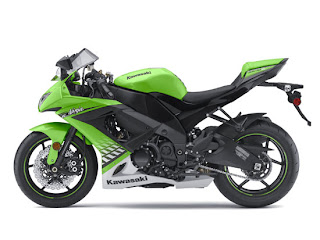
A New kawasaki Motorcycle Ninja ZX-10R for 2010 about the Features and Benefits:
* Aggressive new motorcycle styling of the upper, side and center fairings and cockpit inner covers enhances aerodynamic efficiency and appearance
* Refinements to the shift ratchet assembly, shifting arm, return spring and collar result in reduced friction and less movement at the shift shaft pivot, for improved shifting feel and more positive gear changes
* A new, embossed metallic gray coating on the muffler complements the new bodywork
* A new, 18-position Öhlins steering damper uses additional spring and oil pistons for improved action; titanium color and a laser-etched logo enhance the bikes appearance
* Slightly longer throttle cables inside a plastic throttle housing provide improved throttle action for even greater control
Four-Cylinder, DOHC 998cc Engine
* Very compact, narrow and lightweight design makes it possible to position the engine perfectly within the chassis for optimal weight distribution
* One-piece upper crankcase and cylinder casting saves weight and offers maximum rigidity
* Oil is routed through channels milled into the cases on various parts of the engine, eliminating external oil lines and reducing weight
* Stacked, triangular layout of crank axis, input shaft and output shaft reduces engine length and aids mass centralization for quick handling
* Lightweight crankshaft maintains the same inertial moment as a heavier design but saves about two pounds compared to a conventional crank
* Low friction oil pump reduction ratio reduces parasitic power loss
* Water pump uses the same type impeller as the ZX-14, with pump rpm optimized for reduced friction
* A lightweight Denso radiator with tightly packed cores provides the most efficient engine cooling possible
* Specially designed internal fins on the liquid-cooled, aluminum oil cooler promote high-efficiency heat dissipation
Cylinder Head
* Intake ports, exhaust ports and matched combustion chambers are designed for optimum flow efficiency and high top-end power
* Exhaust ports that are narrower at the midpoint and larger at the opening promote high exhaust velocity and efficient scavenging
* Intake and exhaust valves are titanium for reduced reciprocating weight and higher rpm capabilities
* High-lift camshafts are designed to deliver more power at high rpm and make it easier to tune the engine for racing
Fuel Injection
* Secondary fuel injectors improve top-end power output and power characteristics at high rpm. Lower injectors are always on, upper injectors come on as needed according to degree of throttle opening and engine rpm
* Oval cross-sectioned throttle bodies allow very precise throttle control and instant response
Air Intake
* A highly efficient, center-located Ram Air intake duct is shaped for lower intake noise and higher intake efficiency
* Use of a compact, flat-type fuel pump that takes up less fuel tank space leaves room for a large, efficient airbox
* Oval-section intake funnels promote non-turbulent flow at all rpm
KIMS Ignition
* Kawasaki Ignition Management System (KIMS) helps curtail sudden spikes in engine speed, enhancing the riders control of power delivery
* In addition to standard fuel injection system inputs (engine speed, throttle position, vehicle speed, gear position, intake air temperature, intake air pressure, engine temperature and O2 sensors), KIMS monitors the rate of rpm change every 0.02 seconds
* Designed not to interfere with the riders intentions, the complex ECU program assumes all rider inputs are intentional. However, when a change in engine speed exceeds the predicted response for given parameters, KIMS will slow the ignition timing to reduce power
* Adjustment of KIMS parameters is possible with an accessory racing (circuit-use only) kit installed
Exhaust System
* An exhaust pre-chamber under the engine reduces exhaust noise, minimizes silencer volume and enhances mass centralization for maximum flickability
* A palladium catalyzer helps the ZX-10R meet strict Euro-III exhaust emissions standards
* A single orthogonal, titanium silencer with a new, black finish keeps the center of gravity low and improves exhaust efficiency
Six-Speed Transmission
* Modifications to the shift mechanism further enhance quick, positive gear changes
* Gear ratios suit the power characteristics for ideal power delivery in all rpm ranges
* Final reduction ratio of 17/41 intensifies the ZX-10Rs already awe-inspiring acceleration
* An adjustable back-torque limiting clutch facilitates smooth downshifts, a main contributor to stability under heavy braking
Chassis
* Unique twin-spar aluminum frame features an optimized stiffness balance through a mixture of materials, shapes and thicknesses for superior handling and bump absorption
* Ribbing on the interior of the pivot plate where it joins the frames upper cross member slightly slows down the frames feedback for highly accurate steering feel
* Swingarm pivot located to aid with the front-rear weight balance
* Lightweight, two-piece, aluminum die-cast sub-frame is mounted to the frames upper cross member, so rear suspension feedback is transmitted more directly to the rider
* Narrow sub-frame layout contributes to the compact and slim tail section
Swingarm
* A pressed-beam swingarm delivers a level of feel and feedback unobtainable with a cast unit
* A top-mounted swingarm brace contributes to the superb high-speed stability of the chassis
Suspension
* DLC (Diamond-like Carbon) fork tube coating on the fully adjustable 43mm inverted fork sliders improves fork action by providing reduced friction, smoother action and better road holding
* Bottom-mounted springs are completely submerged in oil for reduced frothing, improved damping performance, superior fork action and road-following ability
* A four-way adjustable rear shock features dual (low- and high-speed) compression damping as well as rebound damping and spring preload adjustment - allowing the fine tuning required for racing
* Kawasaki Genuine Accessory shims are available for quick rear ride height changes at the track
Race-quality Steering Damper
* A new 18-position adjustable Öhlins steering damper is fitted as standard equipment to help ensure stable front end feedback even under racing conditions
Brakes
* Tokico radial-mount brake calipers use dual pads for superb initial bite, increased control and progressive feel
* A radial-pump front master cylinder provides the ultimate in front brake feel and feedback
* A pair of 5.5mm thick, 310mm petal discs provides the heat dissipation needed to maintain brake feel and responsiveness during extended heavy use
* A 220mm rear petal disc gripped by a single-piston caliper provides excellent feel and feedback
Wheels
* Squeeze-cast wheels offer precise dimensions with less wall thickness and weight, yet are stiffer than gravity-cast units
Ergonomics
* The ZX-10Rs rear frame, tank and seat offer high levels of contact with the bike and provide the rider very accurate feedback regarding chassis performance and road surface
* A flared fuel tank top makes it easier for riders to rest the inside of their arm on the tank when leaning into a turn for increased comfort and enhanced feedback
* Narrow in the front and shorter, front to back, for a slimmer riding position, the seat offers a shorter reach to the pavement and excellent chassis feedback
* A rib on the end of throttle tube, under the grip, improves grip and feel
Aerodynamic Bodywork
* Slimmer than ever in new aerodynamic bodywork, the ZX-10R is designed to slice through the atmosphere cleanly at high speed with minimal turbulence
* The front fender aids cooling efficiency by directing air toward the radiator
* A recess on the top of the fuel tank accommodates the helmets chin, so its easier to tuck-in behind the windscreen at speed
* High mounting position of mirrors, with integrated turn signals, provides excellent rearward visibility and helps to minimize damage if the bike falls over
* The flush surface of the tails underside reduces turbulence at the rear of the bike and ensures laminar airflow around the seat
* A large, rear inner fender keeps the bike cleaner and allows the mud flap to be smaller and less obtrusive, further improving aerodynamic qualities around the rear of the machine
* Mirrors, license plate holder and rear turn signals are easily removable for track day prep
* An LED tail light makes the bike more visible to drivers and provides the final styling flourish to the evocative Ninja design
Advanced Electronic Instrumentation
* The easy-to-read instrument cluster uses UV-blocking glass, for maximum visibility
* Multifunction odometer, tripmeter, clock and lap timer/stopwatch are all intuitively easy to use
* The ZX-10Rs big tachometer "green zone" makes keeping the engine in the meatiest part of its massive powerband even easier
Tuesday, July 16, 2013
2011 Kawasaki Ninja 650 R
The nimble 2011 Kawasaki Ninja 650-R deftly combines user-friendly power and excellent handling. The 2011 Kawasaki Ninja 650-R offers serious low-end grunt boosted by digital fuel injection, light weight, and a beautiful chassis that will keep riders smiling from ear to ear whether theyre riding in the canyons or commuting on city streets. Its carefully tuned suspension complete with distinctive side-mounted shock, triple petal disc brakes and light weight make this bike a serious presence in the middle of the Ninja line.The 2011 Kawasaki Ninja 650-R slim structure is due to its compact 8-valve 649cc parallel-twin engine, which permits the use of a narrow, lightweight frame. The fuel injection and ignition settings are tuned to boost the liquid-cooled engines bottom-end torque, to smooth the low-to-mid rpm response and allow the engine to rev quicker. Routing the engine coolant internally to the cylinder and head through the engine cases reduces the number of external hoses. The engine also meets stringent emissions regulations thanks to its precise fuel injection and a three-way catalyst system with a 300-cell catalyzer. The non-intimidating twin cylinder appeals to new riders, and has an excellent mid-range that offers enough pizzazz to thrill more advanced riders. With a natural shift lever position, selecting gears is very easy. The manageable power delivery and superb roll-on response enable the Ninja 650-R to make short work of the morning commute or perform as an entertaining track day companion all while delivering good fuel economy. This spirited sportbikes frame, swingarm and suspension are all designed for minimal vibration and light, quick handling. Rubber upper-rear engine mounts in the signature trellis frame, and rubber-insulated handlebar mounts result in low vibration, for all-day comfort along with great handling. Rider and passenger footpegs are also rubber coated to reduce the amount of vibration transferred to the rider. The natural riding position and ergonomics are enhanced by a slim, low seat which makes reaching the ground easy for increased confidence. Surrounding the 2011 Kawasaki Ninja 650R chassis is unquestionably sporty styling. Avoiding unnecessary design flourishes, the Ninja 650Rs sharp lines flow throughout the bike, giving it an aggressive appearance. The fairings integrated turn signals and a sharp tail cowl highlight the motorcycles compact dimensions. From its windscreen and dual headlights to the high-quality finish of its sleek minimalist fairing, theres little room for doubt about this Ninjas supersport genetics.

Beyond its exciting appearance, MotoGP-inspired multi-function instrumentation and controls, the Ninja 650R is rolling proof that a performance motorcycle can be practical and comfortable. The rider may notice the slimness of the chassis, low seat height and minimal effort controls first before recognizing the true aim of Kawasakis design efforts the rider. The Ninja 650Rs friendly ergonomics provide a versatile cockpit that both novice and experienced riders can use to employ its fullest, from the daily commute to a weekend canyon run. In other words, this real-world overachiever easily demonstrates its versatility and everyday usefulness.
*Authentic Kawasaki Accessories are available through Kawasaki dealers.


2011 Kawasaki Ninja 650-R USA Specifications
MSRP: $7,199 USD
Engine: Four-stroke, liquid-cooled, DOHC, four-valve, parallel twin
Displacement: 649cc
Bore x stroke: 83.0 x 60.0mm
Compression ratio: 11.3:1
Cooling: Liquid
Fuel injection: Digital fuel injection with two 38mm Keihin throttle bodies
Ignition: TCBI with electronic advance
Transmission: Six-speed
Final drive: O-ring chain
Frame: Semi-double cradle, high-tensile steel
Rake / trail: 25 degrees / 4.2 in.
Wheelbase: 55.5 in.
Front suspension / wheel travel: 41mm hydraulic telescopic fork / 4.7 in.
Rear suspension / wheel travel: Single offset laydown shock with adjustable
spring preload / 4.9 in.
Front tire: 120/70x17
Rear tire: 160/60x17
Front brake: Dual 300mm petal discs with two-piston calipers
Rear brake: Single 220mm petal disc with single piston caliper
Overall length: 82.7 in.
Overall width: 29.9 in.
Overall height: 47.2 in.
Seat height: 31.1 in.
Curb weight: 449.8 lbs.
Fuel capacity: 4.1 gal.
Colors: Candy Burnt Orange / Flat Super Black,
Metallic Spark Black / Flat Super Black
Warranty: 12 months

2011 Kawasaki Ninja 650-R - Canada Specifications
MSRP: $8,699 CDN
ENGINE
Type Liquid-cooled, 4-stroke Parallel Twin
Displacement 649 cc
Bore and Stroke 83 x 60 mm
Compression Ratio 11.3:1
Valve System DOHC, 8 valves
Fuel System Fuel injection: ø38 mm x 2 (Keihin)
Ignition Digital
Starting Electric
Lubrication Forced lubrication, semi-dry sump
DRIVETRAIN
Transmission 6-speed, return
Final Drive Sealed Chain
Primary Reduction Ratio 2.095 (88/42)
Gear Ratios: 1st 2.438 (39/16)
2nd 1.714 (36/21)
3rd 1.333 (32/24)
4th 1.111 (30/27)
5th 0.966 (28/29)
6th 0.852 (23/27)
Final Reduction Ratio 3.067 (46/15)
Clutch Wet multi-disc, manual
FRAME
Type Diamond, high-tensile steel
Tire: Front 120/70ZR17M/C (58W)
Tire: Rear 160/60ZR17M/C (69W)
Wheel Travel: Front 120 mm
Wheel Travel: Rear 125 mm
Rake 25
Trail 106 mm
Steering Angle (Left/Right) 32mm; / 32mm
SUSPENSION
Front: Type 41 mm telescopic fork
Rear: Type Offset laydown single-shock with adjustable preload
BRAKES
Front: Type Dual semi-floating 300 mm petal discs
Front: Caliper Dual piston
Rear: Type Single 220 mm petal disc
Rear: Caliper Single-piston
PERFORMANCE
Maximum Power 53 kW {72.1 PS} / 8,500 rpm
Maximum Torque 66 N·m {6.7 kgm} / 7,000 rpm
DIMENSIONS
Overall Length 2,100 mm
Overall Width 760 mm
Overall Height 1,200 mm
Wheelbase 1,410 mm
Ground Clearance 145 mm
Seat Height 790 mm
Curb Mass 204 kg
Fuel Capacity 15.5 L
Fuel Consumption 4.9 L/100 km (58 MPG)
DETAILS
Colours Metallic Spark Black / Flat Super Black, Candy Burnt Orange / Flat Super Black
MSRP* $8,699
Warranty 12 months
ADDITIONAL COST OPTIONS
Good Times Protection Plan 24 or 36 months (Kawasaki GTPP coverage begins after the standard limited warranty expires)
Read more »
Beyond its exciting appearance, MotoGP-inspired multi-function instrumentation and controls, the Ninja 650R is rolling proof that a performance motorcycle can be practical and comfortable. The rider may notice the slimness of the chassis, low seat height and minimal effort controls first before recognizing the true aim of Kawasakis design efforts the rider. The Ninja 650Rs friendly ergonomics provide a versatile cockpit that both novice and experienced riders can use to employ its fullest, from the daily commute to a weekend canyon run. In other words, this real-world overachiever easily demonstrates its versatility and everyday usefulness.
*Authentic Kawasaki Accessories are available through Kawasaki dealers.
2011 Kawasaki Ninja 650-R USA Specifications
MSRP: $7,199 USD
Engine: Four-stroke, liquid-cooled, DOHC, four-valve, parallel twin
Displacement: 649cc
Bore x stroke: 83.0 x 60.0mm
Compression ratio: 11.3:1
Cooling: Liquid
Fuel injection: Digital fuel injection with two 38mm Keihin throttle bodies
Ignition: TCBI with electronic advance
Transmission: Six-speed
Final drive: O-ring chain
Frame: Semi-double cradle, high-tensile steel
Rake / trail: 25 degrees / 4.2 in.
Wheelbase: 55.5 in.
Front suspension / wheel travel: 41mm hydraulic telescopic fork / 4.7 in.
Rear suspension / wheel travel: Single offset laydown shock with adjustable
spring preload / 4.9 in.
Front tire: 120/70x17
Rear tire: 160/60x17
Front brake: Dual 300mm petal discs with two-piston calipers
Rear brake: Single 220mm petal disc with single piston caliper
Overall length: 82.7 in.
Overall width: 29.9 in.
Overall height: 47.2 in.
Seat height: 31.1 in.
Curb weight: 449.8 lbs.
Fuel capacity: 4.1 gal.
Colors: Candy Burnt Orange / Flat Super Black,
Metallic Spark Black / Flat Super Black
Warranty: 12 months
2011 Kawasaki Ninja 650-R - Canada Specifications
MSRP: $8,699 CDN
ENGINE
Type Liquid-cooled, 4-stroke Parallel Twin
Displacement 649 cc
Bore and Stroke 83 x 60 mm
Compression Ratio 11.3:1
Valve System DOHC, 8 valves
Fuel System Fuel injection: ø38 mm x 2 (Keihin)
Ignition Digital
Starting Electric
Lubrication Forced lubrication, semi-dry sump
DRIVETRAIN
Transmission 6-speed, return
Final Drive Sealed Chain
Primary Reduction Ratio 2.095 (88/42)
Gear Ratios: 1st 2.438 (39/16)
2nd 1.714 (36/21)
3rd 1.333 (32/24)
4th 1.111 (30/27)
5th 0.966 (28/29)
6th 0.852 (23/27)
Final Reduction Ratio 3.067 (46/15)
Clutch Wet multi-disc, manual
FRAME
Type Diamond, high-tensile steel
Tire: Front 120/70ZR17M/C (58W)
Tire: Rear 160/60ZR17M/C (69W)
Wheel Travel: Front 120 mm
Wheel Travel: Rear 125 mm
Rake 25
Trail 106 mm
Steering Angle (Left/Right) 32mm; / 32mm
SUSPENSION
Front: Type 41 mm telescopic fork
Rear: Type Offset laydown single-shock with adjustable preload
BRAKES
Front: Type Dual semi-floating 300 mm petal discs
Front: Caliper Dual piston
Rear: Type Single 220 mm petal disc
Rear: Caliper Single-piston
PERFORMANCE
Maximum Power 53 kW {72.1 PS} / 8,500 rpm
Maximum Torque 66 N·m {6.7 kgm} / 7,000 rpm
DIMENSIONS
Overall Length 2,100 mm
Overall Width 760 mm
Overall Height 1,200 mm
Wheelbase 1,410 mm
Ground Clearance 145 mm
Seat Height 790 mm
Curb Mass 204 kg
Fuel Capacity 15.5 L
Fuel Consumption 4.9 L/100 km (58 MPG)
DETAILS
Colours Metallic Spark Black / Flat Super Black, Candy Burnt Orange / Flat Super Black
MSRP* $8,699
Warranty 12 months
ADDITIONAL COST OPTIONS
Good Times Protection Plan 24 or 36 months (Kawasaki GTPP coverage begins after the standard limited warranty expires)
Sunday, July 14, 2013
2009 Kawasaki Ninja 250r Green Edition

2009 Kawasaki Ninja 250r Green Edition. specifications kawasaki ninja 250 r cc. moto sport design. Modification of Custom Motorcycle
Tuesday, July 2, 2013
2010 Kawasaki Ninja ZX 10R With the New Feature Specification

2010 Kawasaki Ninja ZX-10R
2010 Kawasaki Ninja ZX-10R is the latest vehicle for SupersPort class. 2010 Kawasaki Ninja ZX-10R which has a capacity of 998cc engine, Four-stroke, liquid-cooled, DOHC, four valves per cylinder, inline-four. Labor force that offers exceptional but still provide comfort and control to the rider. With better aerodynamics to 2010 Kawasaki Ninja ZX-10R is more rapid and maximal at the energy issue because his prowess in cutting the wind, both on the track straight and when cornering, without reducing the speed to a low point. In 2010 Kawasaki Ninja ZX-10R is a new fitu, one of which is an electronic device called KIMS (Kawasaki Ignition Management System) that serves to share power with maximum control. For example, KIMS can monitor all input and output data such as engine speed, throttle position, vehicle speed, position equipment and feedback from the intake air temperature, intake air pressure, engine temperature and O2 sensors. In addition KIMS is also programmed to prevent the ignition when the engine rpm rises above the program parameters. This is useful for ease, comfort, safety for motorists. 2010 Kawasaki Ninja ZX-10R a great and sophisticated sold for $ 12,999 - $ 13,199. For complete data on the Kawasaki Ninja ZX-10R specifications you can see below.

2010 Kawasaki Ninja ZX-10R

2010 Kawasaki Ninja ZX-10R

2010 Kawasaki Ninja ZX-10R

2010 Kawasaki Ninja ZX-10R

2010 Kawasaki Ninja ZX-10R - Specifications
- Engine: Four-stroke, liquid-cooled, DOHC, four valves per cylinder, inline-four
- Displacement: 998cc
- Bore x Stroke: 76.0 x 55.0mm
- Compression Ratio: 12.9:1
- Fuel System: DFI with four 43mm Keihin throttle bodies with oval sub-throttles, two injectors per cylinder
- Ignition: TCBI with digital advance and Kawasaki Ignition Management System (KIMS)
- Transmission: Six-speed
- Final drive: Chain
- Rake / Trail: 25.5 degrees / 4.3 in.
- Front Tire: 120/70 ZR17
- Rear Tire: 190/55 ZR17
- Wheelbase: 55.7 in.
Front Suspension / Wheel Travel: 43mm inverted fork with DLC coating, adjustable rebound and compression damping, spring preload adjustability and top-out springs / 4.7 in.
Rear Suspension / Wheel Travel: UNI-TRAK® with top-out spring, stepless, dual-range (low-/high-speed) compression damping, stepless rebound damping, fully adjustable spring preload / 4.9 in.
Front Brakes: Dual semi-floating 310mm petal discs with dual four-piston radial-mount calipers
Rear Brakes: Single 220mm petal disc with aluminum single-piston caliper
Overall Length: 83.1 in.
Overall Width: 28.0 in.
Overall Height: 44.7 in.
Seat Height: 32.7 in.
Curb Weight: 458.6 lbs.
Fuel Capacity: 4.5 gal.
Color Choices: Metallic Spark Black, Lime Green/Pearl Stardust White
Warranty 12 months
Good Times™ Protection Plan
2010 Kawasaki Ninja ZX-10R

2010 Kawasaki Ninja ZX-10R

2010 Kawasaki Ninja ZX-10R

2010 Kawasaki Ninja ZX-10R
New Features for 2010 :
Four-Cylinder, DOHC 998cc Engine
- Oil is routed through channels milled into the cases on various parts of the engine, eliminating external oil lines and reducing weight
- Lightweight crankshaft maintains the same inertial moment as a heavier design but saves about two pounds compared to a conventional crank
- Very compact, narrow and lightweight design makes it possible to position the engine perfectly within the chassis for optimal weight distribution
- One-piece upper crankcase and cylinder casting saves weight and offers maximum rigidity
- Specially designed internal fins on the liquid-cooled, aluminum oil cooler promote high-efficiency heat dissipation
- Stacked, triangular layout of crank axis, input shaft and output shaft reduces engine length and aids mass centralization for quick handling
- Water pump uses the same type impeller as the ZX-14, with pump rpm optimized for reduced friction
- A lightweight Denso radiator with tightly packed cores provides the most efficient engine cooling possible
- Low friction oil pump reduction ratio reduces parasitic power loss
- Refinements to the shift ratchet assembly, shifting arm, return spring and collar result in reduced friction and less movement at the shift shaft pivot, for improved shifting feel and more positive gear changes
- Slightly longer throttle cables inside a plastic throttle housing provide improved throttle action for even greater control
- A new, embossed metallic gray coating on the muffler complements the new bodywork
- A new, 18-position Öhlins steering damper uses additional spring and oil pistons for improved action; titanium color and a laser-etched logo enhance the bikes appearance
- Aggressive new styling of the upper, side and center fairings and cockpit inner covers enhances aerodynamic efficiency and appearance
Fuel Injection
- Oval cross-sectioned throttle bodies allow very precise throttle control and instant response
- Secondary fuel injectors improve top-end power output and power characteristics at high rpm. Lower injectors are always on, upper injectors come on as needed according to degree of throttle opening and engine rpm
Cylinder Head
- Intake and exhaust valves are titanium for reduced reciprocating weight and higher rpm capabilities
- High-lift camshafts are designed to deliver more power at high rpm and make it easier to tune the engine for racing
- Exhaust ports that are narrower at the midpoint and larger at the opening promote high exhaust velocity and efficient scavenging
- Intake ports, exhaust ports and matched combustion chambers are designed for optimum flow efficiency and high top-end power
Suspension
- A four-way adjustable rear shock features dual (low- and high-speed) compression damping as well as rebound damping and spring preload adjustment - allowing the fine tuning required for racing
- Bottom-mounted springs are completely submerged in oil for reduced frothing, improved damping performance, superior fork action and road-following ability
- Kawasaki Genuine Accessory shims are available for quick rear ride height changes at the track
- DLC (Diamond-like Carbon) fork tube coating on the fully adjustable 43mm inverted fork sliders improves fork action by providing reduced friction, smoother action and better road holding
Air Intake
- Designed not to interfere with the riders intentions, the complex ECU program assumes all rider inputs are intentional. However, when a change in engine speed exceeds the predicted response for given parameters, KIMS will slow the ignition timing to reduce power
- Use of a compact, flat-type fuel pump that takes up less fuel tank space leaves room for a large, efficient airbox
- In addition to standard fuel injection system inputs (engine speed, throttle position, vehicle speed, gear position, intake air temperature, intake air pressure, engine temperature and O2 sensors), KIMS monitors the rate of rpm change every 0.02 seconds
- Oval-section intake funnels promote non-turbulent flow at all rpm
KIMS Ignition
- Kawasaki Ignition Management System (KIMS) helps curtail sudden spikes in engine speed, enhancing the riders control of power delivery
- Adjustment of KIMS parameters is possible with an accessory racing (circuit-use only) kit installed
- A highly efficient, center-located Ram Air intake duct is shaped for lower intake noise and higher intake efficiency
Chassis
- Lightweight, two-piece, aluminum die-cast sub-frame is mounted to the frames upper cross member, so rear suspension feedback is transmitted more directly to the rider
- Ribbing on the interior of the pivot plate where it joins the frames upper cross member slightly slows down the frames feedback for highly accurate steering feel
- Swingarm pivot located to aid with the front-rear weight balance
- Unique twin-spar aluminum frame features an optimized stiffness balance through a mixture of materials, shapes and thicknesses for superior handling and bump absorption
- Narrow sub-frame layout contributes to the compact and slim tail section
Exhaust System
- A palladium catalyzer helps the ZX-10R meet strict Euro-III exhaust emissions standards
- A single orthogonal, titanium silencer with a new, black finish keeps the center of gravity low and improves exhaust efficiency
- An exhaust pre-chamber under the engine reduces exhaust noise, minimizes silencer volume and enhances mass centralization for maximum flickability
Race-quality Steering Damper
- A pair of 5.5mm thick, 310mm petal discs provides the heat dissipation needed to maintain brake feel and responsiveness during extended heavy use
- A 220mm rear petal disc gripped by a single-piston caliper provides excellent feel and feedback
- Tokico radial-mount brake calipers use dual pads for superb initial bite, increased control and progressive feel
- A radial-pump front master cylinder provides the ultimate in front brake feel and feedback
- A new 18-position adjustable Öhlins steering damper is fitted as standard equipment to help ensure stable front end feedback even under racing conditions
Brakes
Aerodynamic Bodywork
- A recess on the top of the fuel tank accommodates the helmets chin, so its easier to tuck-in behind the windscreen at speed
- An LED tail light makes the bike more visible to drivers and provides the final styling flourish to the evocative Ninja design
- Slimmer than ever in new aerodynamic bodywork, the ZX-10R is designed to slice through the atmosphere cleanly at high speed with minimal turbulence
- The front fender aids cooling efficiency by directing air toward the radiator
- A large, rear inner fender keeps the bike cleaner and allows the mud flap to be smaller and less obtrusive, further improving aerodynamic qualities around the rear of the machine
- Mirrors, license plate holder and rear turn signals are easily removable for track day prep
- High mounting position of mirrors, with integrated turn signals, provides excellent rearward visibility and helps to minimize damage if the bike falls over
- The flush surface of the tails underside reduces turbulence at the rear of the bike and ensures laminar airflow around the seat
Advanced Electronic Instrumentation
- The ZX-10Rs big tachometer "green zone" makes keeping the engine in the meatiest part of its massive powerband even easier
- Multifunction odometer, tripmeter, clock and lap timer/stopwatch are all intuitively easy to use
- The easy-to-read instrument cluster uses UV-blocking glass, for maximum visibility
Thursday, June 20, 2013
Kawasaki Concours 14

When Kawasaki resurrected the Concours confiscate two geezerhood ago with its ZX-14-based (but fundamentally all-new) Concours 14, the floras sassy intention was to put umteen "boast" in the sport-touring category. With the engine and chassis circumscribe tracing even to the superlative Ninja, Kawasaki engineers were perception to create a sport-tourer that was politician at bag stem elevation passes at hurrying than its relative. And they definitely delivered on that communication; in our 08 hypersport-tourer similarity ("Long-Range Missiles", June 08), the Concours 14 bested the arguing despite a few niggling issues by good of its superlative all-around present.
Kawasaki conducts a lot of sharpen set activity with its customers, and they pioneer that serving the Concours 14 multitude was realistic zealous almost their likes on the new deceiver, they were also very unrelenting on what improvements they felt were indispensable. And interestingly sufficiency, those improvements all concentrated on making the C14 galore homy for the requisite haul-not so copiousness in any extent of corner-carving show.
But with the rife system conditions forcing statesman manufacturers to see rearwards on introducing any theater updates on their new models, it was uncomplicated to belie that the Concours fans would be ready at negligible a sewing or two illustrator for an upgraded exhibitionist.
So overmuch for the formulaic thought. In a precipitate win timeline ordinarily seen in the solon nonclassical hardcore supersport grouping, Kawasaki has sprung a hard updated Concours 14 on the travelling wide for 2010-a human two eld after its accounting. And the table of improvements are numerous and essential; minute of them are conscionable bolt-on updates, and its leisurely to see that whatsoever honest datum (and R&D money) was spent artful and testing the Kawasakis new components.
We were hypothesis the chance to see the new Concours 14 firsthand for a day in the mountains above the apply municipality of Exploit Springs, Calif., and came forth sage that Squad Place isnt pleasing this aggregation gently.
Thursday, June 13, 2013
2012 Kawasaki Ninja ZX 14R Review Specs and Pictures
2012 Kawasaki Ninja ZX-14R Review, Specs and Pictures - 2012 Kawasaki Ninja ZX-14R Review
The designation R Equals More Race Winning Power and More Refinement for Open-Class Sportbike Ultimate

This must be the ugly compete ZX ™ -14 year after year. When arriving at the big-bore sportbike stage in 2006, the big Ninja ® blew everyones minds - owners, journalists and competitors - with its incredible, comfort thrust sport-tourer, agile handling and aerodynamic full-coverage bodywork. Continuous improvement has made 14 steps ahead of the competition, all while filling enthusiasts face shield with wild, ear-to-ear grin.
Fortunately for Kawasaki fans (and unfortunately for the competition), there was no let up for 2012. Not only is the newly R-designated Ninja ZX-14R massively more powerful, its also almost entirely new, with more of the character, design excellence, and finesse youve come to expect from Team Green ™ - the company that has built a legendary open-class motorcycles for over 40 years.
Big power delivered smoothly has always been a big Ninja hallmark, so the changes for 2012 begin at bay ZX-14R new engine. First, there is more movement through increased 4mm stroke, up to 65mm (up from 61mm), with displacement now registering 1441cc (up from 1352cc). The new combustion chamber shape is optimized for 2012, and their surface-milled now, not cast. Intake ports are reshaped and polished for maximum flow while working in concert with the intake valves longer and more durable. Yep, the Ninja ZX-14R new really come "ported" right from the factory.
The camshafts working those valves are more radical, with increased lift and revised profiles, while stronger cam chain and revised tensioning system maximize reliability at the stratospheric rpm levels this engine is capable of. Newly designed forged pistons with thinner crowns offer durability and less weight increased, and cooled by oil jet cooling system that pumps a continuous flow of new oil under the piston, respectively. (Tests show engine runs much cooler with this system.) Theres more: Compression is up from last year, connecting rods have beefier small ends, and are made of stronger material, crankshaft main journals are thicker, from 38 to 40mm, an air new-cleaner element is larger and thicker, with 10% more surface area and the ability of 40 percent more airflow and transmission gear was hot and the surface-treated to be more durable and shift more smoothly.
2012 Kawasaki Ninja ZX-14R Specs
- Engine: Four-stroke, liquid-cooled, DOHC, four valve per cylinder, inline-four
- Displacement: 1,441cc
- Bore x stroke: 84.0 x 65.0mm
- Compression ratio: 12.3:1
- Fuel system: DFI with four 44mm Mikuni throttle bodies
- Ignition: TCBI with Digital Advance
- Transmission: Six-speed
- Final drive: X-Ring chain
- Rake / trail: 23 degrees / 3.7 in.
- Front tire: 120/70 ZR17
- Rear tire: 190/50 ZR17
- Wheelbase: 58.3 in.
- Front suspension / wheel travel: 43mm inverted cartridge fork with adjustable preload, 18-way compression and 15-way rebound damping adjustment / 4.6 in.
- Rear suspension / wheel travel: Bottom-link Uni-Trak® and gas-charged shock with adjustable preload, stepless rebound and compression damping adjustments, adjustable ride height / 4.9 in.
- Front brakes: Dual semi-floating 310 mm petal discs with dual radial-mounted four-piston calipers
- Rear brakes: Single 250mm petal disc with twin-piston caliper
- Overall length: 85.4 in.
- Overall width: 30.3 in.
- Overall height: 46.1 in.
- Ground clearance: 4.9 in.
- Seat height: 31.5 in.
- Curb weight: 584.3 lbs.
- Fuel capacity: 5.8 gal.
- Color: Metallic Spark Black, Candy Surf Blue,
- Golden Blazed Green with special graphics (SE)
- MSRP standard / special edition: $14.699
- Warranty: 12 Months
- Metallic Spark Black / $14,699
- Candy Surf Blue / $14,699
- SE Golden Blaed Green with graphics / $14,899
2012 Kawasaki Ninja ZX-14R Pictures


Thanks For Rading "2012 Kawasaki Ninja ZX-14R Review, Specs and Pictures", See Also "2012 Ducati Monster 1100 EVO Review, Specs and Pictures"
Friday, June 7, 2013
2013 Kawasaki Ninja ER 6f Review Specs Price Picture
2013 Kawasaki Ninja ER-6f Review, Specs, Price, Picture - 2013 Kawasaki Ninja ER-6f pictures, prices, information, and specifications. Here is information on the 2013 Kawasaki Ninja ER-6f From Motorsport and Sportbike Of OneMotorcycles. If you want to get a quote on a new 2013 Kawasaki Ninja ER-6f use our Build Your Own tool, or Compare this bike to other Kawasaki motorcycles.

2013 Kawasaki Ninja ER-6f Review
Finding a two-wheel streetbike thats competent in each on-road task, and will all with passion and usefulness, is extremely rare. Motorcycles achieving this level of accomplishment square measure few in numbers, however greatly appreciated as trendy rides wrapped around AN exciting core. Since its debut back in 2006, the multi-talented Ninja® 650R sportbike has been a real member of this upper crust, winning accolades from homeowners and media alike.
This sensible sportbike options an excellent trying perimeter-style frame, and angular bodywork to assist set it except the gang. the straightforward to browse analog and digital instrumentation, responsive engine performance, and a cushty seat that isn’t too tall for shorter riders, permit the Ninja ER-6f to shine in virtually any role, from track days to traveling to sport moving.
This sensible sportbike options an excellent trying perimeter-style frame, and angular bodywork to assist set it except the gang. the straightforward to browse analog and digital instrumentation, responsive engine performance, and a cushty seat that isn’t too tall for shorter riders, permit the Ninja ER-6f to shine in virtually any role, from track days to traveling to sport moving.

It all starts within the engine bay, wherever a complicated, extremely compact, liquid-cooled 649cc parallel twin works its magic with facilitate from a digital fuel injection system (DFI®) system that includes 38mm throttle bodies with sub-throttles for precise supply and optimum response. This ultra-narrow engine produces substantial power with many character – particularly down low and within the mid-range – from a formidable array of technology, as well as double overhead camshafts performing on eight light-weight valves. light-weight pistons run in plated, linerless cylinders, whereas a 180-degree crank assembly – plus a balancer shaft – maintains a stunning level of smoothness.
This has forever been a superb streetbike engine – torquey, smooth, and happy to rev, with enough satisfying low- and mid-range oomph to please novices and specialists alike. Figure within the Ninja ER-6f’s calculable 50-mpg* fuel economy, precise fuel injection system and its pleasing twin-cylinder throb, and you’re viewing what simply could be the foremost versatile and satisfying streetbike engine on the world.

2013 Kawasaki Ninja ER-6f - United Kingdom Specifications/Technical Details
UK MSRP Price: £6099 (Prices are recommended and inclusive of VAT @ 20% and delivery)
UK MSRP Price: £6099 (Prices are recommended and inclusive of VAT @ 20% and delivery)
Engine
"
Engine type
Liquid-cooled, 4-stroke Parallel Twin
"
Displacement
649 cm3
"
Bore x stroke
83.0 x 60.0 mm
"
Compression ratio
10.8:1
"
Valve/Induction system
DOHC, 8 valves
"
Fuel system
Fuel injection: ø38 mm x 2 (Keihin)
"
Ignition
Digital
"
Starting
Electric
"
Lubrication
Forced lubrication, semi-dry sump
Transmission
"
Transmission
6-speed, return
"
Final Drive
Sealed Chain
" Primary reduction ratio
2.095 (88/42)
" Gear ratios: 1st
2.438 (39/16)
" Gear ratios: 2nd
1.714 (36/21)
" Gear ratios: 3rd
1.333 (32/24)
" Gear ratios: 4th
1.111 (30/27)
" Gear ratios: 5th
0.966 (28/29)
" Gear ratios: 6th
0.852 (23/27)
" Final reduction ratio
3.067 (46/15)
"
Clutch
Wet multi-disc, manual
Frame
"
Frame type
Perimeter, high-tensile steel
"
Rake/Trail
25o / 110 mm
"
Wheel travel, front
125 mm
"
Wheel travel, rear
130 mm
"
Tyre, front
120/70ZR17M/C (58W)
"
Tyre, rear
160/60ZR17M/C (69W)
"
Steering angle, left / right
35o / 35o
Suspension
"
Suspension, front
41 mm telescopic fork
"
Suspension, rear
Offset laydown single-shock with adjustable preload
Brakes
"
Brakes, front
Type: Dual semi-floating 300 mm petal discs Caliper: Dual piston
"
Brakes, rear
Type: Single 220 mm petal disc Caliper: Single-piston
Dimensions
"
Dimensions (L x W x H)
2,110 mm x 770 mm x 1,180 mm
"
Wheelbase
1,410 mm
"
Ground Clearance
130 mm
"
Seat height
805 mm
" Fuel capacity
16 litres
"
Curb Mass
209 kg / 211 kg (ABS)
Performance
"
Maximum power
53 kW {72.1 PS} / 8,500 rpm
"
Maximum torque
64 N.m {6.5 kgf.m} / 7,000 rpm


2013 Kawasaki Ninja ER-6f Pictures
Thanks For Reading "2013 Kawasaki Ninja ER-6f Review, Specs, Price, Picture".
Subscribe to:
Posts (Atom)